Showing posts with label Year 13 Film : FS6 Gendered Film Studies. Show all posts

Thursday, 16 April 2009

It's Ladies night...oh what a night!

Here's a fabulous 'Gender' website full of brilliant links, essays, reviews and goodies to support you with your development of a debate around 'Gender' representations in the films we have studied. With an essay due-in n ext week, some wider reading around the three texts studied will definately support you with your writing.


Plus, a couple of extra goodies on Thelma and Louise and The Piano:

http://www.mith2.umd.edu/WomensStudies/FilmReviews/T/thelma+louise-mcalister


http://www.mith2.umd.edu/WomensStudies/FilmReviews/the-piano-mcalister

Wednesday, 15 April 2009

Some useful notes on 'The Piano' by Jane Campion


The Piano - Melodrama and representations of Gender through Binary Opposites

The colonial dimension of The Piano (it is set on a ‘plantation’ in New Zealand), points us neatly towards a further set of theoretical ideas suggested by the social anthropologist Claude Lévi-Strauss. Genre theorists borrowed Strauss’ idea of a conflict structure based on binary oppositions to explain how many genre films were constructed. The oppositions which we can find in colonial melodramas are striking and provide us with useful insights into how a colonial narrative produces meaning. These narratives are based on ideas and values that the characters are likely to have had at the time. Consider the following oppositions:

White Settler ‘Native’

Civilised
Savage
Educated
Ignorant
Controlled
Wild
Sexually restrained
Sexually promiscuous
Moral
Amoral
Rational
Superstitious

You can probably come up with further oppositions which explain how the Victorian settlers viewed ‘native’ peoples. These are not necessarily presented as straight opposites. Rather, they map out a terrain. The European melodrama is rarely interested in the ‘colonised’ peoples, so the main work of the melodrama narrative is to look at the struggle of white male and female settlers to develop a healthy emotional state in the midst of the overpowering ‘otherness’ of the colonial environment. Usually it is the white woman who ‘succumbs’ – this always been thought more shocking than the white male with the ‘native girl’. In terms of mise en scène, it is worth thinking about the colonial environment, in which the heat, the scents of spices and exotic flowers, the strange animals and spectacular landscapes all appeal to the senses (‘arouse’ emotions) more than the familiar ‘home’ environment.

In The Piano the woman is drawn, not directly to a native (Maori) figure, but instead to a white man who has ‘gone native’ – in some ways an even more despicable figure for respectable society than the native male (who can sometimes be stereotyped as the ‘good native’ or the ‘noble savage’). The white man who adopts native habits has not only betrayed his own culture, but has also degraded what is worthwhile in native culture. When you see The Piano you should find little difficulty identifying sequences in which these binary oppositions are emphasised and which clearly propel the narrative forward. What makes The Piano particularly interesting (and perhaps led to some of the controversy over reactions to the film) is that the central woman character is also trapped in another set of oppositions – as a woman in the strictly patriarchal Victorian society. She has been sent/brought to New Zealand essentially as a piece of male property. Her transgression – the affair with Baines – is doubly marked, she has both broken out of her marital relationship, her enslavement as property, and sullied herself with a ‘degenerate’ man.

It is this double marking or ‘over determination’ which makes The Piano so much a melodrama. We have emphasised so far that melodrama mise en scène is expressive and excessive – everything seems to be exaggerated, almost to the point of hysteria. In this context, over determination can apply to both the events – piled on top of each other – and particular aspects of the mise en scène. To take just one example, much comment has been made about the costumes in The Piano. The woman wears a crinoline – a voluminous skirt supported by a rigid cage. This is both supportive (the woman and her daughter use the crinoline as a tent when they are landed on the beach) and restrictive (as she tries to cross the uneven and boggy ground – the endless rain is also a potential sign of sexual release). This supportive/restrictive clothing also provides great erotic excitement for the man in terms of what it hides and obstructs him from accessing.

The double marking of the woman in The Piano means that the colonial ‘discourse’ or argument is to a certain extent obscured by the feminist discourse – does our positive response to what the woman achieves by breaking out of her unhappy marriage prevent us reading the colonial discourse?

Exercise
Try to map out the oppositions you think might be relevant for middle-class men and women in Victorian society. Which qualities would be expected from men rather than women etc.? What other binary oppositions can you identify?

Some Useful Definitions when exploring gendered cinema at a macro level:
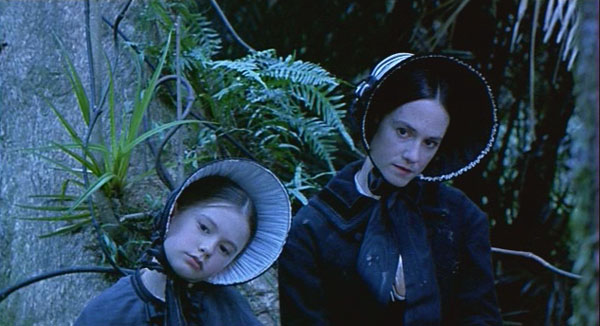
Woman’s Picture – like youth pictures, these films are defined by their audience address rather than by specific themes or styles. The central characters will be women and the narratives will centre on issues important to women. Some films may be ‘romances’ or comedies. Many of the 1940s melodramas were targeted directly at the disproportionately large female domestic audience during the war years. They were often disparagingly termed ‘weepies’ or ‘tearjerkers’. A more modern variant is the idea of the ‘chick flick’.

Defining Melodrama - Action films tend to be ‘goal-orientated’ - they progress to a particular resolution such as the war is won, the killer is captured etc. Action narratives have conflicts which are tackled through action - characters go out and do something. It follows from this that the editing of sequences to represent movement by characters is of central importance. By contrast, melodramas are about relationships between characters and the resolution of a melodrama narrative concerns the restoration of one or more relationships, or their replacement by others. In a sense, melodramas are more ‘circular’ than ‘linear’. The conflicts in melodramas can often not be resolved by ‘action’, it is the failure of characters to act or even to speak about ‘the problem’ which creates the conflict. The emotional struggle in a melodrama must be expressed or ‘displaced’ in some way. Instead of the editing of action sequences, melodramas deal in mise en scène, performance and music.

Extract taken from original posting on following blog: http://itpworld.wordpress.com/category/womens-film/


Some Extra 'Piano' goodies to assist you in the exploration of Gender representations:


An exploration of gender representations in the film:

Book chapter on gender themes in The Piano and Thelma and Louise

Cambridge University Press Film Analysis
http://assets.cambridge.org/97805215/92581/sample/9780521592581wsn01.pdf

Feminist Critique of 'The Piano'
http://diana.saco.name/Female_Gaze.htm

Wednesday, 1 April 2009

Cindy Sherman representing Female Cinematic Roles


Uploaded on authorSTREAM by mjarry

Gender Representations in Campion's 'The Piano' - Some Easter Holiday Work!


We will finish watching Campion's 'The Piano' tomorrow and I am looking forward to hearing your responses to the film. It offers a complex representation of gender and seeks to challenge notions of patriarchy. Over the Easter holiday, I would like you to write an essay in response to the three films watched. Choose 1 of the following essay questions and using the three key films studied (Tomb Raider, Thelma and Louise & The Piano) and any other examples, answer one of these over the Easter holiday:

GENDERED FILM STUDIES

  • Explore the benefits of applying a gendered critical approach to studying film with reference to specific case studies.
  • Is it too simple to say that some films target male audiences and other target female audiences?
  • How does a focus on gender contribute to the understanding of meaning and value in films?
  • What is the ‘male’ camera debate? Does film language create a gendered ‘look’?
  • What is to be gained by considering the position of a male or female spectator?
  • Does mainstream film represent male and female characters differently? Might this determine whether the spectator can identify with or objectify the character?
  • How might gender affect the construction of male and female stereotypes and/or stars?

The following article will help to inform your knowledge and understanding of the 'The Representation of Gender/Femininity in The Piano' and is a MUST read: 

From its beginnings, the film industry generally excluded women from the film-making process.
http://www.associatedcontent.comarticle/49323/the_representation_of_genderfemininity.html


Study Guide for Jane Campion’s “The Piano” (1993): Some questions to guide your thinking about the film -

Jane Campion’s “The Piano” takes place in mid-19th century New Zealand. Do some research about the colonial history in New Zealand and see how it helps you understand film.
Do some research about Jane Campion’s filmography to identify the common themes in her work.

  • How does the opening sequence help you understand Ada?
  • Why is Ada described as a “mail-order bride”?
  • What does Ada’s muteness signify in the film?
  • How do you think the New Zealand landscape with its forests, thick mud, sea and beach helps us understand the film?
  • What does a comparison between Stewart’s house and Baines’ house reveal about these two characters?
  • Analyze the characters of Stewart and Baines in relation to their relations to Ada and to the Maori.
  • Examine Stewart’s and Baines’s clothes and discuss what they reveal about these two men.
  • What does “land” mean to Stewart? What does it mean to the Maori?
  • Examine the piano metaphor in the film. What meaning(s) does it carry for different people in the film? Why does Ada need to claim it back?
  • What does Ada’s physical appearance (e.g. her clothes, her hair style) reveal about her and the society in which she lives?
  • Why do you think there is so much emphasis on buying and selling in the film? (Suggested reading: Ann Hardy’s “The Last Patriarch” in “Cambridge Film Handbooks: Jane Campion’s The Piano”, Harriet Margolis (Ed.), page. 72, 1st Edition, 2000)
  • What is the function of the Bluebeard play show in the film?
  • Identify the imagery of whiteness and blackness in the film and discuss what such imagery reveals.
  • What does Flora stand for in the film? How would you explain the change in Flora’s attitude towards her mother?
  • Identify some phallic symbols in the film and discuss their significance.
  • What is the symbolic value of Stewart’s cruel punishment of Ada? In this part of the film how does Jane Campion encourage the viewers to identify with Ada?
  • Do you find Campion’s portrayal of the Maori stereotypical? Why? Why not? Give your reasons.
  • Examine Laura Mulvey’s argument of “male gaze” in her famous article “Visual Pleasure and Narrative Cinema” (1975) and discuss to what extent and in what ways patriarchal conventions in filmmaking are challenged in Jane Campion’s “The Piano”.
  • Examine the relationship between Ada and the men around her in the light of French anthropologist Levi-Strauss’s theory of exchange.
  • What helps you identify the narrative voice in the film?
  • What is your interpretation of the film’s double ending?
  • Explore the theme of power struggle in the film.
  • Do you think the film makes a successful critique of phallocentrism? Give your reasons.
  • What link does the film establish between colonialism and patriarchy?
  • Jane Campion quoted in Judith Lewis’s “Wholly Jane”, L.A. Weekly, January 27, 2000:”The laws of men and women in Western society are carefully unwritten,… And feeling them, facing up to them, is like the pain of having a baby — no one will ever tell you about it, really, because it’s just beyond communicating. It’s so bad, so big, so enormous, that you can’t describe it or even believe it. In a way it’s the same for women feeling the world, facing the world. I don’t even talk about it, because it sounds like whingeing. But I’m not whingeing. I’m screaming.”
  • “I like to be able to project myself into the parts,…. and being a woman I like to therefore have heroines. We don’t have many, you know? So I feel like it’s my job. Not a crusade - just a natural thing to want to do.”
  • In light of the quotations above, discuss Jane Campion’s rationale in film making in relati

Sunday, 29 March 2009

FS6 Gendered Film Studies - Easter Holiday Essay

The following questions are examples of 'debate' questions posed to students in past papers in the FS6 exam Film Studies exam (2 Hours to answer 3 questions: Shocking cinema; Censorship and Regulation & Gendered Film). Choose 1 of the following essay questions and using the three key films studied (Tomb Raider, Thelma and Louise & The Piano) and any other examples, answer one of these over the Easter holiday: 

GENDERED FILM STUDIES
  • Explore the benefits of applying a gendered critical approach to studying film with reference to specific case studies.
  • Is it too simple to say that some films target male audiences and other target female audiences?
  • How does a focus on gender contribute to the understanding of meaning and value in films?
  • What is the ‘male’ camera debate? Does film language create a gendered ‘look’?
  • What is to be gained by considering the position of a male or female spectator?
  • Does mainstream film represent male and female characters differently? Might this determine whether the spectator can identify with or objectify the character?
  • How might gender affect the construction of male and female stereotypes and/or stars?

Sunday, 22 March 2009

Thelma and Louise Screenplay by Callie Khouri

Thelma & Louise, by Callie Khouri Thelma & Louise, by Callie Khouri Giorgos

Thelma and Louise - Positive or Negative Representation of women?


Everyone in 13 Film has now seen 'Thelma and Louise' and this week we will begin to critically examine the film and its wider reception exploring whether it can be deemed a positive representation of women in light of the film's closure? This reader will be used in class to examine some of the wider debates. If you get a chance, have a read before this week's lesson. Also, the link below offers an interesting insight into legal debates surrounding this film. Louise would have been tried for murder and been punished by 'death' in America. In light of the film's ending and Thelma and Louise's experiences of rape, this article questions the American legal system and its prejudice towards women. Interesting and worthy of a look!

http://tarlton.law.utexas.edu/lpop/etext/okla/wiegand22.htm
Thelma and Louise Gender Representation Analysis
This is another useful article to further your study of Thelma and Louise with the author talking with screenwriter Callie Khouri about character development. 
Thelma and Louise Thelma and Louice bhaskarchow

Wednesday, 18 March 2009

Year 13 Film - Butt Kicking Babes Display Competition

Butt Kicking Babes

Here's the challenge...I've got a pair of cinema tickets up for grabs for the best 'Butt Kicking Babe' poster created by Yr 13's doing Gendered Film Studies. Choose your favourite or most inspirational 'Butt Kicking Babe' and create a poster (A3 Pref) which gives some insight into the character and some of her distinct traits that make her iconic. She doesn't have to be an action heroine either - just a strong and empowering female character!

DEADLINE - THURSDAY 26TH MARCH 2009

Butt Kicking Babes - If you liked our Lara Croft debate, read on...

Butt Kicking Heroines

Monday, 2 March 2009

Year 13 Film : Lara Croft - Feminist Icon or object of desire for the Male Gaze? Today's Debate.


Some notes on Tomb Raider:

"Lara Croft" may seem like an empowering role model for some women because of the way she triumphs in an apparently male-dominated world. However, Lara merely comes across as an object designed to inspire male fantasy as demonstrated by her clothing, demeanor, and relationships, all of which beckon for attention from a predominantly male audience.
Lara's haughty behavior and demeanor not only broadcast the false message that a woman needs to be improper to succeed, but are also used in a way to shamelessly draw male attention.
Lara doesn't have any men in her life at first gives the impression that she is a strong, independent woman. Though, she is actually quite dependent on her father, while the absence of a male by her side invites the male viewer to occupy that empty space in his imagination.

"Thus, male clothing becomes synonymous with victory over males, and Lara ostensibly becomes a symbol of female empowerment as one who transcends the overwhelming obstacles set forth by a male dominated society - all with the aid of her attire. In actuality, however, Lara's victory-by-apparel suggests that if a woman is to succeed in a male dominated world, she must wear a man's clothes, which ultimately disassociates her with her feminine identity, despite the feminine features her clothing may accentuate. Instead of signaling empowerment, Lara's clothes acknowledge that one must possess male traits in order to excel in an openly male-dominated world."

Sunday, 1 March 2009

A'level Gendered Film Studies: From Lara Croft to Thelma and Louise


I really enjoyed the level of debate that followed the screenings of 'Tomb Raider' in Film last week and can't wait to read your blog entries on the question I posed:


Lara Croft: Feminist Icon or object of sexual desire for the male gaze?

The formal debates to be held this week in my lessons will be brilliant. Some of you have got real 'fire in your belly' about the representations and this will inevitably lead to some 'hot' debate. Fantastic. Just to stoke your fires a bit further, here is a small extract from a Guardian article I sourced on the film:

"The girls with supernatural powers were unsuper. They were more like alcoholics. So I turn to the girls with superskills, beginning with Lara Croft, as played by Angelina Jolie in Lara Croft Tomb Raider: The Cradle of Life. Lara is like the girls I was at school with: an ordinary suburban cow who talks like Liz Hurley and lives in Buckinghamshire. Her quest is to find Pandora's Box, the source of the world's grief, before evil scientists get hold of it.

Lara drives a motorbike along the Great Wall of China and sky-dives off a bank, but just as I am beginning to relax, The Message pops up. "Do you ever do anything the easy way?" asks her colleague. "You're afraid of letting anyone in," says her lover, who is the sort of man deaf-blind women pick up in Soho after a crack binge. Lara shoots him, snivels and strikes the noble superheroine-in-solitude pose. Do you understand, ladies? Superwoman can't have a super relationship or super contentment and the pay-off for her super gift is isolation, loneliness, misanthropy and, eventually, no doubt, super-arthritis."

http://www.guardian.co.uk/film/2005/jul/01/gender.world

The next film to follow on from our study of Tomb Raider is Ridley Scott's 1991 hit 'Thelma and Louise' chosen because of its social and historical significance and because like Tomb Raider, the two central female protagonists exist in a traditionally 'male genre world' and challenge/subvert the codes, conventions and audience expectations of the traditional 'Buddy Road Movie'. Here is the opening title sequence to set the mood:


The film was the subject of considerable praise and controversy. Filmed for a modest 17 million dollars, the movie was a great commercial success but the critics were far from uniform in their enthusiasm. Reviewers referred to the two female protagonists with such wildly disparate descriptions as “daring anti-heroes” (Maslin, 1991a, p. C1), “outlaw princesses” (Rafferty, 1991), and “killer bimbos” (Grenier, 1991), practicing “guerrilla feminism” (Baber, 1991). Controversy raged over whether those that revelled in Thelma and Louise's antics were engaging in “a strikingly adolescent hostility towards men” (Merkin, 1991).

It will be lovely to hear what you have to say about this important film that will be screened and deeply deconstructed as part of our study of gendered film. Below are some academic links to aid you with your 'deep' study of the film and some questions for consideration in your analysis:

Resources
'Guardian' newspaper dedicated 'Gender News' area on their website:
http://www.guardian.co.uk/world/gender

Thelma and Louise Gender analysis 1
http://www.katpad.co.uk/media%20website%202000/Thelalouise.html


T
helma and Louise Gender Analysis 2
http://tarlton.law.utexas.edu/lpop/etext/okla/wiegand22.html


Some ideas/questions I want you to consider when critically deconstructing Thelma and Louise by Ridley Scott:

Notice how the camera gives shape and texture to the worlds the two characters pass through. Pay attention to both interior and exterior spaces—bars, gas stations, and hotels as well as roads, rocks, and canyons. How does the director use these surrounding spaces to help tell the story in visual terms? Also, pay attention to how the camera looks at the two main characters. Notice the use of close ups of each character by herself or shots of the two of them together. How does the film’s visual narrative enhance our understanding of plot and character?

What 'moral' messages and values does the film communicate?
What is “the moral” of the movie? Is it, as one (male) reviewer put it, “toxic feminism,” a trashing of men that deserves to be “universally. . .condemned”? Or is it what we might describe as tonic feminism, a morality tale that forces men to be held accountable for their oppression of women and gives women the satisfaction of seeing female characters act to enforce an alternative, anti-patriarchal code of ethics and etiquette? What do you think the film says about relations between men and women in contemporary culture—communication, violence, the struggle (by women and men) to break free of the coercive power of gender roles and norms?

Women’s Narratives of Transcendence & Containment
HETEROSEXUALITY = containment
TRANSCENDENCE = realizing one’s self, courage that dares and defies what society dictates possible within the social organisation of heterosexuality for these women?

“Success” for Thelma = married & taken care of, at least financiallly, by Darryl
“Success” for Louise = marrying Jimmy
YET Thelma leaves Darryl without asking permission; Louise says NO to Jimmy, whom she loves

Thelma looking at landscape in the side mirror: “You awake? My eyes are open. I feel awake. I never remember feeling this awake. Everything looks different.”

Considering whether it’s plausible to say Thelma & Louise are “going on” to lesbian possibility, think about the following:
  • They have exhausted heterosexual possibilities
  • Thelma in effect starts to “defeminize” herself--she becomes much more androgynous in her dress, looking more and more like the “gentleman robber.” For that matter, Louise defeminizes herself as well (trading her jewelry, the accoutrements of heterosexuality, for the old man’s hat)
Consider their relationship to MAPS, or patriarchal designs on things:
  • Maps represent a patriarchal way of navigating the world: reading one, Thelma says, “can’t get to Mexico without going through Texas.”
  • According to that map, Louise must traverse the scene of her violation (presumably a rape) or get caught
  • They throw that map away, but they have no maps to guide them
If all of this inspires you. Why not join the Thelma and Louise Club:

http://www.thelmandlouise.com/index.php

Wednesday, 11 February 2009

Year 13 Film : Lara Croft - Feminist Icon or object of desire for the Male Gaze?


"Lara Croft - Feminist icon or object for the 'Male Gaze'? The juxtaposition of physical prowess and sexuality continues to produce a great deal of ambivalence amongst feminist and non-feminist commentators about this character." http://www.gamestudies.org/0202/kennedy/

In this week's lesson we are going to begin to watch Tomb Raider. I want you to make notes whilst watching the film. Use the following questions to guide your notes:

1. Describe and Explain in some detail how cinematic conventions like camera angles, movement and position, mise-en-scene, sound, costume, lighting and editing have contributed to the construction of a 'male gaze' by creating Croft as an object of a voyeuristic gaze.

2. Is there any evidence of fragmentation?

3. Is Croft a contradicory character? Powerful women action adventure heroes can be contradictory offering both a voyeuristic eroticised view and at the same time portray a powerful female figure. What's your interpretation? Support with examples.


http://news.bbc.co.uk/1/hi/technology/6641833.stm

Tuesday, 10 February 2009

Year 13 Film Studies - FS6 Gendered Film Studies: Constructed by the Gaze

Now that we have finished our FS4 Small Scale Work, I want to move back into the realms of Gendered Film Studies. To get you back into the world of 'Mulvey' and debates about 'The Gaze', here is a lovely wee film all the Gaze. Enjoy. 


A series of clips that clearly exemplify 'The Male Gaze' and notions of 'Fragmentation' across a body of contemporary Hollywood films.


The Bond films have always objectified women and this is well evidenced in this little movie 'The Bond Gaze"


This is a useful link exploring Mulvey's theory in more detail and applying it to a body of films. 
http://www.freewebs.com/elizabethbarnes/

I'm looking forward to the final presentations in Thursday's lesson - Langford and Dani will both be presenting their small-scale research. We will then be ready to commence our journey back into the world of gendered film studies. I am hoping that you have been active in putting my feedback into action and refining your FS4 Small Scale Presentation Scripts and drafting your evaluations for March 15th. Don't leave it until the last minute - work systematically and it will pay dividends. See you on Thursday. x

Sunday, 4 January 2009

A' level Film Studies - Gendered Film Studies New Topic 09

Happy New Year to you all. I hope you have had a lovely, restful holiday and feel ready for the challenges of this term. We have 12 weeks to secure your A'level and Team Media and Film will have high expectations. In Film Studies we are going to begin the FS6 Section C Topic 'Gendered Cinema'.  This exam paper is 'synoptic' in nature which means you are expected to draw upon a wide variety of film texts from prior study and films you watch both inside and outside the classroom. We are going to be looking in the main at femininity in film but will be exploring the construction of gender identities (male and female)through film language; the complex relationship between gender representations, audiences and institutions; gendered film theory and applying this to key texts that will form our critical examination of the debates. We will be looking at: 
Boys Don't Cry / Thelma and Louise / The Piano and possibly Point break. In addition to this clips from Alien, Terminator, Fight Club, Mulan, Dr No, Casino Royale, and a plethora of other movies will be used to highlight debates.

There are already some links to this topic on the blog that I posted last year, so feel free to dip into these that can be found under the label of 'Year 13 Film: FS6 Gendered Film Studies'. I will add lots of resources both here and under the 'Learning Resource Zone' to support you with your study of this topic. So here are a few to get us started:

YouTube Links:
Women in Bond Films 'The Bond Gaze'
http://uk.youtube.com/watch?v=pfL09c4cw2I


This site is full of useful articles about Women and their role in the Hollywood Film Industry. The site is called 'New York Women in Film and TV' and it is worth browsing some of the other articles on this site:
http://www.nywift.org/article.aspx?id=84

This is a useful blog exploring 'Feminist Film Studies' and is jam packed full of useful links and resources:
http://blog.lib.umn.edu/raim0007/wost3307/

Some of you have already explored representations of femininity in Disney films in your Critical Research Study for Media. The knowledge derived from this unit should be used in film and here is a great little chapter about Mulan that is seemingly an empowering film for women but argues that Mulan does in fact conform to 'Patriarchal' expectations:
http://www.ubcpress.ca/books/pdf/chapters/2007/CinematicHowling.pdf


Saturday, 8 November 2008

Keeping a 'Gender Journal' for Film Studies

Keeping a 'Gender Film Journal' as we move through the study of Gendered Cinema for FS6 is a great way to both document and explore the complexities of this topic. Why not use  some of these superb link sites to widen your knowledge and understanding of the debates then write-up your responses on your blog or in your journal. 

Feminist Film Studies
This is a great site which highlights the continued patriarchy that 'Hollywood' presents in terms of providing opportunities for women to get to the top of their vocation in film:
http://www.guerrillagirls.com/

This next site set up by the BFI looks at 'Women in Film' from a British perspective and offers insight into less well known Women directors like Sally Potter and Lynne Ramsay
http://www.screenonline.org.uk/film/id/824060/index.html

Here is a fantastic link to Warwick University's blog to support any students Media or Film studying Women and Film. Have a look for yourself.....it's loaded with really interesting and useful contextual stuff about patriarchy and issues affecting women in society today. Fab for Film and Critical Research Study in Media.
http://blogs.warwick.ac.uk/michaelwalford/entry/women_film_the/


Masculinity In Crisis 
A look at this topic in relation to David Fincher's awesome 'Fight Club'. 
http://xroads.virginia.edu/~ma02/freed/fightclub/masviol.html